Posts

What are the world's officials, generals, writers, actors and athletes say about Josip Broz Tito ?!

Image
Elizabeth II meeting Josip Broz Tito during a visit to Yugoslavia  According to the official publication, Josip Broz Tito died on 4 May 1980 at 15:05 hours after prolonged treatment in a hospital in Ljubljana, where he was previously due to health complications amputated a leg. Respect for the Tito and his army did not show only allies, but also the war enemies. What did they say about Josip Broz by his contemporaries - - Winston Churchill, Heinrich Himmler, Franklin D. Roosevelt, Charles de Gaulle, Yasser Arafat, Neal Armstrong, Richard Burton, Willy Brandt, Miroslav Krleza, Mirza Delibasic ... Meeting With Josip Tito And President Eisenhower, New York 1960 Dwight Eisenhower , the American president, and general: "Tito is the greatest hero of World War II." Marshal Tito and Winston Churchill. Winston Churchill , in August 1944: "The reason why we stopped to help Draza Mihailovic and his Chetniks is simple. He did not fight against ...

The ZSU-57-2 in service of the Yugoslav People's Army

Image
The ZSU-57-2 (Ob'yekt 500) is a Soviet self-propelled anti-aircraft gun (SPAAG), armed with two 57 mm autocannons. 'ZSU' stands for Zenitnaya Samokhodnaya Ustanovka (Russian: Зенитная Самоходная Установка), meaning "anti-aircraft self-propelled mount", '57' stands for the bore of the armament in millimeters and '2' stands for the number of gun barrels. It was the first Soviet mass-produced tracked SPAAG. In the USSR it had the unofficial nickname "Sparka", meaning "pair", referring to the twin autocannon with which the vehicle is armed. Croatian ZSU-57-2 in Vukovar war museum During 1945 was made a smaller amount of the new self-propelled vehicle ZSU PA-37, which was based on a self-propelled vehicle SU-76m, such as the armored turret body mounted to open one gun K-61, 37 mm caliber. This weapon has retained all the bad characteristics of SU-76M, above all, not strong and unreliable engines. The total has ...

Missile system S-125M1T "NEVA" The rocket, which broke the myth of stealth technology

Image
S-125 Neva missile systems for air defense of the territory. This missile system surface-to-air (Eng. Surface-to-air missile system) is produced in the Soviet Union 60 years of the 20th century. It is still in use in many countries, including Serbia. In recent years, carried out the modernization of the system, which allows it to use, and in today's conditions. NATO name for the system is the SA-3 Goa. The missile system S-125M1T "NEVA" included: - station for guiding a rocket (STVR: IME antenna body, the measuring, and calculation UNK- M) and cabin for thermal imaging system - cabin for distribution supply RCU-N - electrical station 5E96A - start equipment (4 launchers 5P73 with 4 missiles 5V27U / D, a vehicle for the supply and installation of missiles PR-14AM) - mobile repair facility PRM-NM1 - acquisition observation station (OACt) P15 (P12) - Cable Kits Military Museum in Belgrade, at Kalemegdan, set up missile system S-125 Neva,...

Interesting facts and figures on the Balkans on June 1941

Image
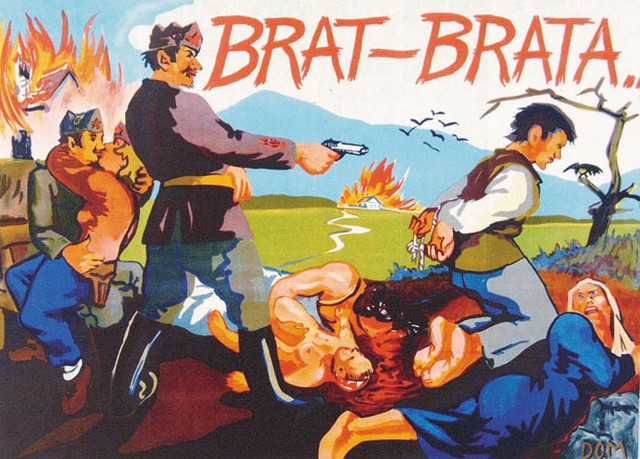
German propaganda poster against the uprising in Yugoslavia shows partisans as fratricide, fornicators, and arsonists. 2. 6. - started Ustasha slaughters around Ljubinje and in the village Drežanj near Nevesinje, where on June 3, comes to armed resistance. 2. 6. - Germans begin repression against civilians in Crete (Kondomari massacre, shooting in Alikianos). Civilians being shot during the Massacre. 4. 6. - The agreement between Germany and the Independent State of Croatia in Zagreb about the deportation around 200,000 Serbs in Serbia, and the same number of Slovenians in Croatia. 5. 6. - The uprising in NDH 1941 .: around Gacko in Herzegovina began a spontaneous uprising provoked by the Ustasha violence. 5. 6. - A large explosion of stored of ammunition in the Smederevo fortress - almost all the houses in Smederevo damaged, about 5,000 victims. 5. 6. - The meeting of Ante Pavelic and Hitler at Berchtesgaden. 6. 6. - Appeal of King Peter ...

Battle of Crete

Image
More German paratroops landing on Crete from Junkers 52 transports, 20 May 1941. Battle for Crete known code-named Operation Mercury was the largest airborne operation carried out by the German parachute regiment during World War II. The battle began on 20 May 1941 and ended the German Pyrrhic victory because the losses of German airborne forces were extremely high. Negative experience gained during the Battle for Crete forced the German military leadership to make a decision on cancellation of the planned large-scale airborne operations for which the German parachutists to the end of the war, fought as infantry. German paratroopers (Fallschirmjäger) landing on Crete, May 1941 The Battle of Crete was the first occasion where Fallschirmjäger (German paratroops) were used en masse, the first mainly airborne invasion in military history, the first time the Allies made significant use of intelligence from the decrypted German messages from the Enigma machine and the fi...