Posts

Showing posts with the label cetnici

REPORT OF THE COMMAND OF THE SIXTH INFANTRY DIVISION FROM JANUARY 25, 1943 TO THE HEADQUARTERS OF THE HOME DEFENSE REGARDING THE CONVERSATION WITH DOBROSAV JEVDEVlČ
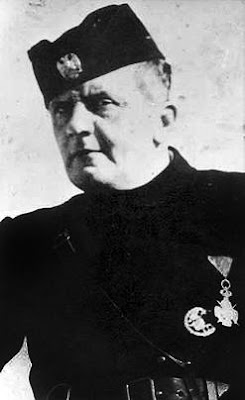
Image
  Contemporary WWII photograph of Jevđević, almost face-on, in ceremonial uniform with a medal COMMAND MOST URGENTLY                                                                                                                PERSONALLY AT HAND 6 INFANTRY DIVISIONS Op. Number 823/taj.   In Mostar, on January 25, 1943 Subject: preliminary talks with Jevđević. — TO THE HEADQUARTERS OF THE HOME DEFENSE "Op." — 3 — TO THE GENERAL MILITARY COMMISSIONER N.D.H. — SUŠAK   Today, in the private apartment of the police colonel Mr. Stjepan Jakovljević, commander of the 6th military regiment, held the first meeting of the representatives of our authorities with the leader of the Serbs, Dob...

Attacks on garrisons Independent State of Croatia

Image
  Fighters of the Mostar Battalion on the move towards Kupres, 1942. Attacks on garrisons were, along with attacks on communications, an integral part of partisan strategy and tactics developed on the territory of occupied Yugoslavia during World War II. These attacks had multiple meanings: They enabled the formation and expansion of free territory They were a way of supplying troops and people in the free territory They were an important part of the effort to weaken the enemy militarily, politically, and morally. The uprising in occupied Yugoslavia in September 1941. The Independent State of Croatia was formed with the help of occupation troops, but as a puppet creation without sufficient support among the people, it failed to gain control over its territory during the entire war. The administrative system of the NDH was very shaken by the uprising of the NDH in 1941. Later during the war, especially from the middle of 1942, the NOVJ managed to force the NDH to strategically defen...

Interesting facts and figures on the Balkans in April 1942

Image
Soldiers of the Black Legion at Koševo, Sarajevo. April 1 - A black legion from Han-Pjeska captures Vlasenica (during the month it commits crimes against civilians and inflicts losses on Chetniks in eastern Bosnia).  The Black Legion is a colloquial name for the infamous elite unit of the Ustasha army that operated during the Second World War on the territory of the then Independent State of Croatia, ie today's Bosnia and Herzegovina and Croatia. Members of that unit committed a large number of atrocities against the Serb population in the NDH  April 4 - "Croatian Orthodox Church" founded in the Independent State of Croatia, Patriarch Germogen Maksimov enthroned on June 7. Pavelić, Artuković,  Germogen The Croatian Orthodox Church was an Orthodox church that officially operated in the areas under the rule of the Independent State of Croatia from 1942 to 1945 during the Second World War.  April 9 - Operation Trio: Ustasha Black Legion breaks out of the plan on the Dri...

Military and paramilitary formations in the Balkans during World War II PART II

Image
Chetniks of Kosta Pećanac Kosta Pecanac with germans Chetniks of the Kosta Pecanac, also known as "black" Chetniks, "legal chetniks" or "government chetniks" were formations in Nedić's Serbia. They were loyal to the marionette regime and the German military administration, and they fought primarily against the partisans. Chetnik detachments Kosta Pecanac, formed on June 28 in 1941. Mainly in 1942, representing, with smaller detachments of the gendarmerie and later the Serbian Volunteer Corps, the main armed force quisling regime of Milan Nedic. They existed until the end of 1942 when they were gradually replaced by Ljotić and Nedić's formations. Anti-Communist Volunteer Militia Coat of Arm of unit MVAC. Anti-Communist Volunteer Militia (Milizia Volontaria Anti Comunista, abbreviated MVAC) was the organization of auxiliary military units within the Royal Italian Army to combat the Partisan uni...

Military and paramilitary formations in the Balkans during World War II PART I

Image
The Flag of the Democratic Federation of Yugoslavia, used by the Partisans The National Liberation Army and the Partisan detachments  of Yugoslavia was the armed force of the anti-fascist movement of resistance in occupied Yugoslavia, led by the Communist Party of Yugoslavia (Yugoslav National Liberation Army, NOVJ), the full name of the National Liberation Army and Partisans of Yugoslavia (NOV and POJ), the shorter and more popular partisans. Yugoslav Partisans considered being the most successful movement of resistance in occupied Europe. Josip Broz Tito in Bihać, 1942. NOVJ was formed in June 1941 by the formation of the first Partisan detachment. March 1, 1945, has grown into the Yugoslav army, the regular military formation of the Democratic Federal Yugoslavia. The National Liberation Army was headed by the Supreme Staff, and its members were called Partisans. The Partizan strategy rejected the holding of the fronts. At the beginning of the war, the...