Posts

Anti Partisan operations in the Independent State of Croatia

Image
Sabotage action on the railway line Sarajevo-Visegrad, September in 1941. Operation Visegrad The guerrilla war in Yugoslavia, which lasted from 22 June 1941 to May 1945 was more extensive and picked up more victims than they took the war in the Soviet Union from June 22 to July 1944, mainly in Belarus. Communist partisans led by Tito, except for the German army, they had to contend with Italian, Bulgarian, Hungarian, and the military NDH and the Chetniks and dozens of other insignificant collaborationist militia and groups. The war in Yugoslavia was unique. In this war, they made war with the invaders, nationalist, collaborators, and allies of the Axis against the Partisans. At the same time, it was a civil war, revolution, and war of appeasement. Destroyed enemy transport on the railway line Sarajevo - Visegrad 24 August 1941. Duration: September 30, 1941 - December 4, 1941. Objective: Destroy the Chetniks concentrated around Rogatica 40 km east of Sarajev...

The story of the Yugoslav giant who worked for Boeing and Airbus: Today Yugoslav aircraft manufacturer Soko is only abstract noun

Image
The headquarters of SOKO, which still exists, the surface is 450.000m², and the main plant, there are plants in Citluk, Grude, Ljubuski and Nevesinje, with a total of approximately 8,000 employees (of which 5,000 in the parent plant. Soko was a Yugoslav aircraft manufacturer based in Mostar, SR Bosnia and Herzegovina. The company was responsible for the production of many military aircraft for the Yugoslav Air Force. In 1948, the Yugoslav leadership came up with the idea to build a factory for program production aircraft. The idea was realized next when the Yugoslav Government took the decision to build a factory in Mostar. The reasoning was set to be the factory located in the area of the main sources of electricity and materials for production, but the key is the selection of Mostar was the distance from the eastern borders of Yugoslavia at the time of turbulent relations with the USSR. How important was that the Sokol had to move aircraft factory Ikarus in Zemun...

Blitzkrieg

Image
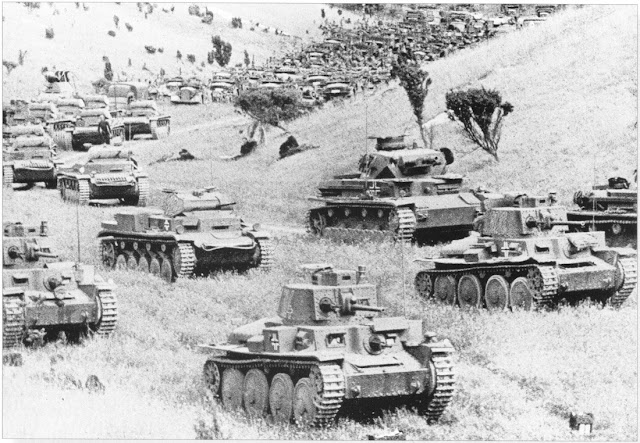
The fast and surprising success of the German army in the war against the Polish, and later on the Western Front, depended on the new tactics attacks that sent known as Blitzkrieg. How was performed tactic of Blitzkrieg is simplified in the next picture? Phase 1 Infantry's ability at attacking the enemy lines and used a smokescreen to conceal the movement of his troops. Meanwhile, dive bomber (Junkers Ju 87 or Stuka) and artillery isolated combat position by opponent sever ties with his reserve and disorganize resistance. Sometimes, the surprising and fast attack on enemy positions using paratroopers. Behind the occurrence of infantry standing The majority of forces waiting to go on the attack Phase 2 The main forces move into action quickly in the form of a wedge on the most important point of the defense. Tank units quickly penetrate forward and artillery protects flanks of the main forces. Infantry units destroyed The last resistance in front...

PT 76 Reconnaissance armored vehicle

Image
PT 76 7 DOW TBiU 12 PT-76 (rus. Plavayushchiy Tank - an amphibious tank) Soviet light amphibious tanks developed immediately after World War II. During production, which lasted from 1950 until the late 1960s we had around 12,000 copies. Map of PT-76 operators in blue with former operators in red The main purpose is reconnaissance, forcing the water barriers and fire support for infantry amphibious assault. Despite his age and poor shielding for modern conditions of warfare, and today is a part of many armed forces. Polish PT-76 The interior of the tank is divided into three parts: the front of the seated driver, fighting position in the middle and rear motor. The crew consists of a driver, fillers, and commanders who also acts as a gunner and radio operator. On the dome, there is a large oval lid that opens to the front. The driver other than the standard input in the tank and dispose of the opening at the bottom that is used in emergencies and it can...

The German Operation Autumn storm

Image
Operation Autumn storm (Ger. HERBSTGEWITTER) was a Wehrmacht military operation against partisans in the area of Dalmatia in the fall and winter of 1943. It took place in several stages. Autumn storm I started on 23 October 1943. Autumn Storm II was conducted from 20 to 27 December 1943. After that, the operation was extended named Morgenwind ("Morning wind"). The operation "Autumn Storm" was conducted for taking the group of south dalmatian islands: Korcula, Mljet, Hvar, Brac and Solta, which defended parts of the 26th NOU division. The goal of the operation was to be taking these islands provide part of the Adriatic coast on a section of Split - Dubrovnik from possible Allied unloaded in cooperation with units of the NLA. This operation was part of the sixth enemy offensive. The goal of the operation "HERBSTGEWITTER I" was taking the Peljesac peninsula. Commanding the operation had the SS Div. "Prinz Eugen". The forces wi...

Excellent animation of the Great Patriotic War

Image
Victory in the Great Patriotic War was an act of bravery and glory of our people. However, the opinions and the interpretation of the historical facts changed since, May 9, the Victory Day, remains unchanged. Eternal Glory to the Victors! Full version with clickable events here: http: //english.pobediteli.ru/flash.ht ...

Operation "Snowstorm"

Image
Members of the 3rd Battalion, 2nd Regiment (14th SS Regiment), 7th SS Volunteer Mountain Division "Prinz Eugen", salute the graves of their comrades killed (by the  Partisans ) on Christmas Eve, near the village of Duboštica (among the fallen is the battalion adjutant, SS-Untersturmführer Hans Hanel, and soldiers Weber and Binder). Two years later, most of these men will also be lying under the ground by Christmas time. Those rare few, who were temporarily spared for trial, celebrated the holiday in captivity in the following way (a memoir of Wilhelm Ebeling, officer of the "Handschar" Division, quote from the book "Forward, Prinz Eugen!" by Otto Kumm): "A good-natured NCO is on duty this evening. We asked him for permission to sing several songs and to have the lights left on a little longer. He generously granted it. Then began our Christmas. We had no candles and no pine branches [...] We softly sang some Christmas songs [...] There were...