Posts

Escape of 1st Proletarian Brigade from German encirclement known as Igman march

Image
The breakthrough of the 1st Proletarian Brigade, led by Koca Popovic, through the German encirclement is known as The Igman March. This breakthrough was made at the night of 27th January 1942 via the Sarajevo Field and Igman Mountain. The German and Ustasha forces have launched an operation called „Southern Croatia“ in Eastern Bosnia in mid-January 1942. Operation „Southern Croatia“ had an objective to surround and destroy the 1st Proletarian Brigade. The Germans have engaged the following forces: 342nd and 718th  Infantry Division, 1st Battalion of the 714th Infantry Division, 7th Ustasha Domobran's battalion, six howitzer batteries, two Pioneer detachments, and two reconnaissance squadrons. On the other side, the Partisan unit was comprised of the 1st Proletarian Brigade, Romanija detachment, Ozren detachment, and Zvijezda detachment. At the beginning of the operation, the Germans have realized their plan with fast maneuvers. They managed to encircle the Pa...
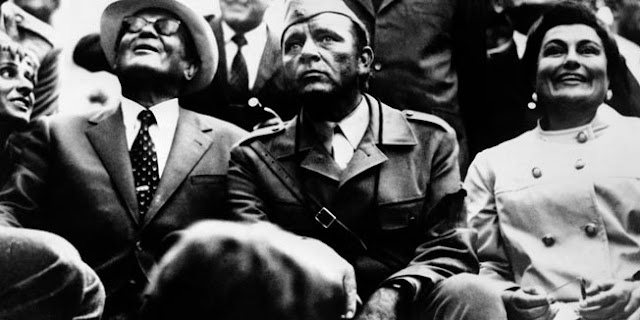
Did you know that Richard Burton played Tito in the movie Sutjeska

Image
''The Battle of Sutjeska'' is a Partisan war movie directed by Stipe Delic. It was  made in 1973 in the SFR Yugoslavia.   It tells the story about the famous Battle of Sutjeska , the greatest engagement of the  Yugoslav Partisan War . This movie was made for the 30th anniversary of the battle. It was filmed at the authentic site where the battle took place in 1943, in the National Park Sutjeska, also known as the Valley of Heroes.   It is one of the most expensive movies in the history of Yugoslav cinema . Tito has personally participated in the making of this movie. He insisted that his character was played by the famous British actor Richard Burton. At that time, Richard Burton was at the peak of his career. A lot of information about his experience in Yugoslavia was discovered later in his book. Hoewver, he does not specify how it came to the engagement. According to some sources, Richard and Elizabeth Taylor were having dinner with the Princess Ma...

7 German Offensives in Yugoslavia in WWII Part I

Image
The National Liberation War was led between the people of Yugoslavia and four Axis occupying forces. The Axis occupying forces were Germany, Italy, Hungary, and Bulgaria, but they were also supported by their locally collaborationist forces: the Independent State of Croatia, the Croatian nationalists Ustashas, the Home Guardsmen, the troops of General Nedic, the troops of Dimitrije Ljotic, the Balists (Albania), Bela Garda, and the Chetnik movement led by Draza Mihailovic. The National Liberation War in Yugoslavia lasted from July 1941 until May 15th 1945. During this period, the Axis forces engaged a large number of soldiers. Year Axis forces Partisan troops Ration 1941 620.000 80.000 8:1 1942 930.000 150.000 6:1 1943 920.000 300.000 3:1 1944 720.000 500.000 2,4:1 1945 680.000 800.000 1:1,3 Table.1. Ratio strength between the A...

Underground Airbase Željava

Image
Given that Zeljava is a huge complex of underground and overground military facilities, it has been quite a challenge to write an article about it. Therefore, in this article, I will try to present the most important information about the Airbase Zeljava. Zeljava is the largest underground military airport of the former Yugoslav People´s Army (JNA), and it is also one of the largest underground airports in Europe. It is located on the border of the two countries, Bosnia and Herzegovina and Croatia, near the town of Bihac. Hence, it was also known as the Bihac airport. The airport has been fully operating from 1968 until 1992, when it was destroyed during the withdrawal of the JNA by activating explosives. The Socialist Federal Republic of Yugoslavia (SFRJ) invested approximately $6 billion in its construction. In the end, only ruins remained. Potential endeavors to reconstruct the airbase are limited by a lack of financial resources.

TITO'S NUCLEAR SHELTER

Image
Yugoslavia was in a difficult situation at the end of WWII. The country was destroyed, devastated and robbed. Post-war reconstruction of the country implemented slowly because of the conflict between Tito and Stalin that took place in 1948.Another  reason was  the deterioration in relations between East and West. Therefore Yugoslavian leadership realized that Yugoslavia would be the most affected in the case of biginning WWII. So, Tito and his General staff had to find a safe place for the headquarters in case of nuclear war. Tito and his General staff  decided to build a shelter in Bosnia. Bosnia was chosen because of its geostrategic position, situated in the center of Yugoslavia and it's high mountains. The  object with code name „Object D 0 ARC“ (Army Reserve Command) was built near the town Konjic on a right bank of the Neretva River below mountain Zlatar. The Object D 0 was build from March 1953 to November 1979. Around 4.6 bilion US D...